
Today, we are all well aware of the importance of using surgical gloves. We know that they serve as a protective barrier to prevent the transmission of diseases between a healthcare worker and their patient. But did you know who truly popularized their use?
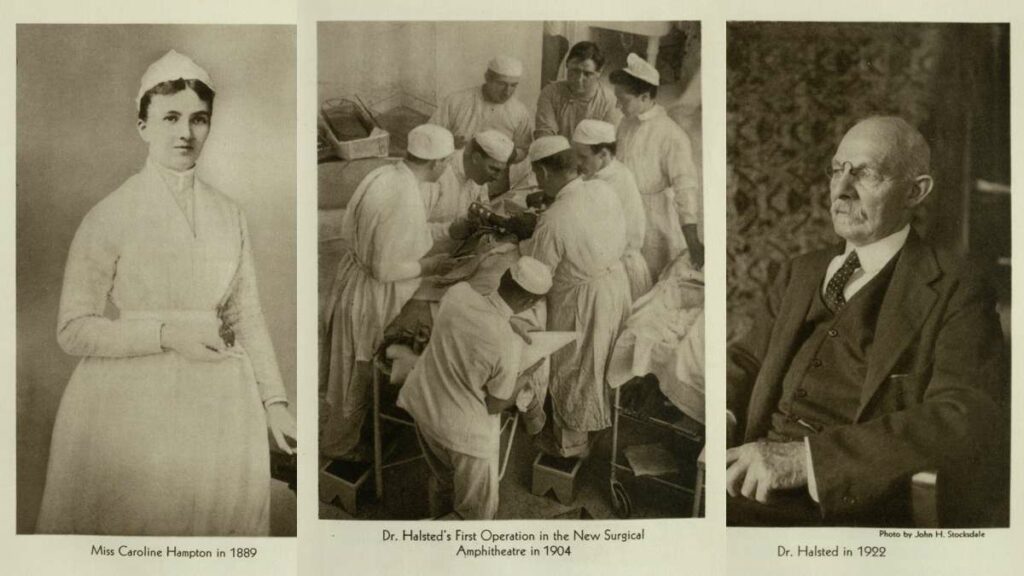
Caroline Hampton, a surgical nurse at John Hopkins, almost quit her job due to severe eczema caused by surgical disinfectant. Her boss bought her custom rubber gloves as a solution. Other staff members copied this.
How Did the Surgical Glove Come to Be?
Personal protective equipment is commonly seen and used because of the current pandemic. Today, we see everyone donning masks and gloves for a simple trip to the grocery store. While it may be obvious now that it is essential to wear protective gear to prevent infections, it has not always been the case. Back in the day, doctors refused to wear gloves during surgery.
Doctors would often credit Dr. William Halsted with introducing the gloves to the surgical theater. But this is not entirely accurate. It wasn’t Halsted who introduced the protective wear. In fact, it was Halstead’s nurse who did – Caroline Hampton. (Source: Science History)
Who is Caroline Hampton?
Hampton came from a family of aristocrats from South Carolina. She was related to Wade Hampton, a famous Confederate lieutenant general. Her mother passed away due to tuberculosis when she was less than a year old in 1862. Her father died in the Civil War a year later. Their family’s fortune was lost after William Tecumseh Sherman’s forces burned the Hampton plantation down. Her aunts raised her in a small home behind the ruins of their old family manor.
Hampton was groomed to be a Southern Belle, but she had bigger ambitions than being a simple plantation owner’s wife. In 1885, she announced that she would be moving to New York to get an education and earn a living for herself.
She became a nurse and was qualified to assist in surgery by 1889. This is because of her dexterity and cool and calm demeanor. Hampton then accepted the job of the chief surgical nurse at Johns Hopkins Hospital. She moved to Baltimore and worked under Dr. William Halsted. (Source: Science History)
Who is William Halsted?
At the time, William Halsted was regarded as one of the most brilliant minds in surgery. He trained with the top surgeons in Europe and settled in New York. The innovative procedures he developed for operating on gallstones, blood vessels, thyroid glands, and hernias truly changed how the surgery was done. Halsted was best known for his work on radical mastectomy to treat breast cancer.
After Halsted experimented with cocaine as a topical anesthetic, he started using the drug himself and got addicted. This nearly ruined his career. After a series of trips to rehab and getting hooked onto morphine, Halsted settled as a functional addict. (Source: Science History)
The Introduction of the Surgical Gloves
Halsted truly appreciated Hampton. She was a brilliant and sharp nurse. In fact, he would often praise her for her exceptional efficiency as his assistant during surgery. In the winter of 1889, Hampton came to him and announced her resignation. She was having trouble with her hands and how the disinfecting protocol was not killing germs but destroying her skin. Hampton developed rashes and eczema, which caused her skin to peel. She loved her job, but the pain was unbearable.
As a solution, Halstead suggested that she coat her hands in a collodion solution. Unfortunately, the collodion would crack whenever she would flex her fingers. They then came up with a novel solution – gloves. Hampton recalled her plantation days and how gardening gloves helped protect her sensitive hands.
Halsted paid to get plaster casts made of Hampton’s hands. He then had two pairs of rubber gloves commissioned by the Goodyear Rubber Company of New York. While these weren’t the first gloves made for medical procedures, it paved the way to the surgical gloves we have today. (Source: Science History)